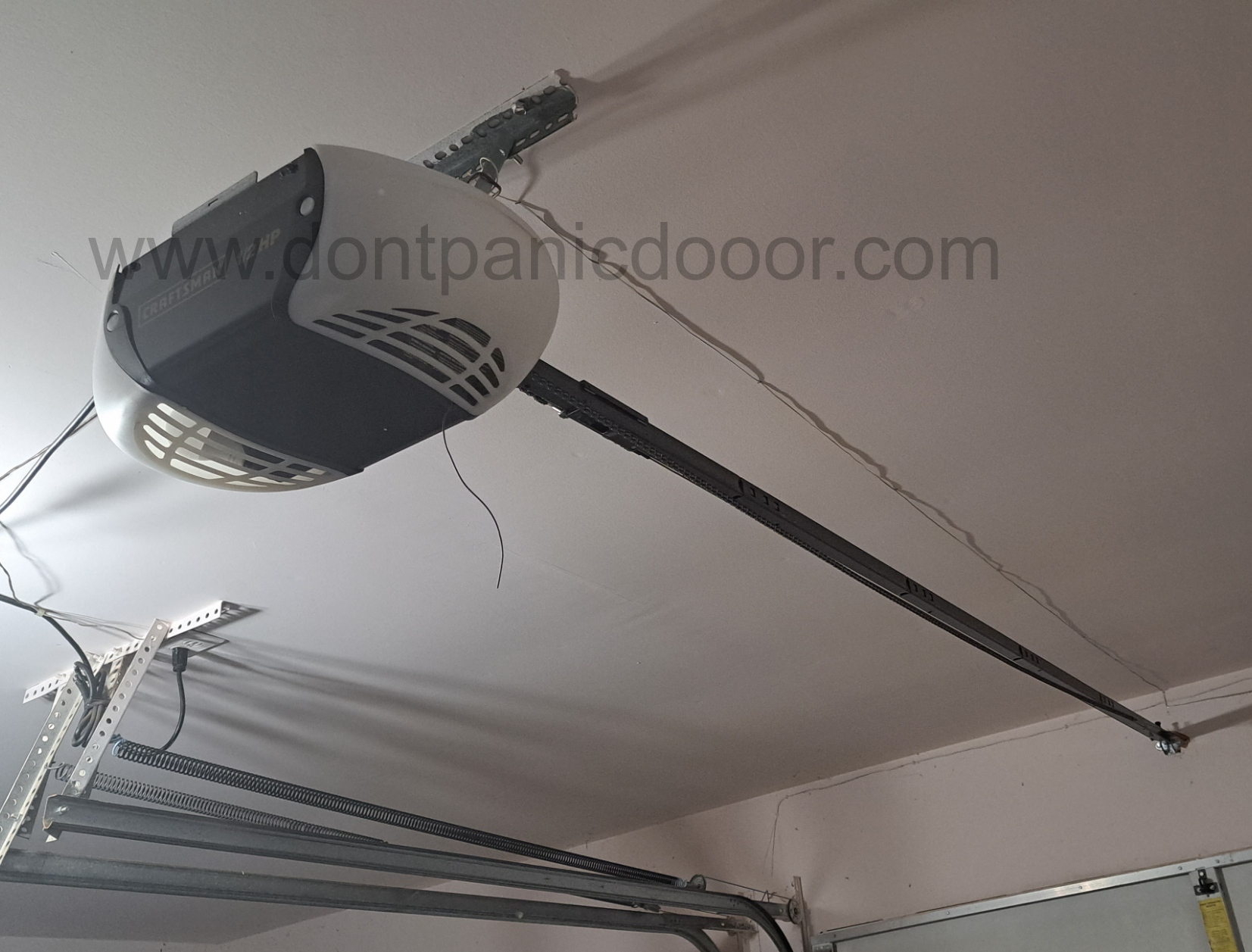
A garage door opener, sometimes called an operator, is an appliance that performs the task of opening and closing a garage door. An opener is a completely separate issue from the door itself. The opener has a relationship to the garage door similar to the relationship between your lawn and your lawnmower. Your lawn needs to be cut thereby creating the need for a lawnmower. Similarly, your garage door needs to be opened and closed thereby creating a need for an opener.
A garage door’s spring system does the work of lifting about 95% of the door’s weight. The opener (or your muscles if lifting by hand) manages the remaining 5%.
I find that many people think about their garage door – garage door opener combo so seldom that they are not aware of what parts they see in their garage are garage door parts and which are opener parts. Many times a customer has told me that they need a new “door” when actually they meant “garage door opener”. A simple but confusing error. Also, they will say they need a new “opener” when they really mean to say “remote transmitter”. The remote transmitter is not the opener. The opener, sometimes called the “operator” is the actual machine that opens and closes the door.
Springs are a part of the door, not a part of the opener.
Please click here for info on parts of the door for identification purposes.
Parts Of The Opener
Compared to the number and complexity of garage door parts, garage door opener parts are few and relatively simple.
They generally consist of:
- The motor
- The rail
- The j bar
- The photocells
- The wall button
- The remote transmitter
The motor or motor head is the part of the opener that contains the actual drive motor and the majority of the electronics for the system.
The rail is the long, slender part that extends from the front of the motor to the wall mount just above the garage door.
The J-bar is a curved bar, shaped vaguely like a letter J. The top of the J-bar connects to a carriage or traveler of some sort on the rail. This carriage is what actually moves when the opener runs. The bottom of the J-bar connects to a bracket which is bolted to the garage door itself, always on the top section, fairly near the top of that section.
The photocells are a portion of the electronics and what they do is inform the motor electronics when there is an obstruction in the way of the door. They usually take the form of two small units, held by brackets, bolted to the frame of the garage door opening or clipped onto the garage door track itself, one on either side of the garage door about five inches off the floor. Mainly they are designed increase safety for children who may be in the vicinity of the garage door. One of the photocells emits a beam of infrared light and the other photocell receives that beam at the opposite side of the garage door opening. If anything blocks this beam the garage door opener will not close the garage door. Photocells are not foolproof. Children allowed to play in or near the garage should be supervised by an adult even if the garage door opener has photocells.
The wall button is usually located near the entry door, screwed to the wall and is the main user interface for opener operation. The wall button may be a simple button resembling a doorbell button. This kind of wall button can only be used to run the opener. Or it may be a “wall console” which in addition to the usual “Go” button has other functions such as a light control button for the motor head’s light bulb and a “lock” button. Some wall consoles also will display information such as time, temperature and system status. The wall button is normally “hard wired” to the motor and requires no batteries.
Remote transmitters, or simply “remotes” are normally located in your car and allow the user to run the opener from within the car. Normally the remote can only be used to open and close the door. The buttons on the remote are “Go” buttons only. They can not control the lights on the motor or the “lock” function. Remotes have batteries which need to be replaced periodically. The batteries are specialty items which may be found at your local hardware store. Radio Shack® sells them for sure. The buttons on remotes will tend to wear out after many years of use requiring replacement of the unit. Replacement remotes can often be found at your local hardware store.
Measure For A New Opener
A standard garage door opener is only long enough to fully open a standard seven foot tall garage door. If you have an eight foot tall garage door, an extra long opener which is rated for an eight foot tall door is what you need. So, before you order or purchase a new garage door opener you might want to measure the height of your garage door.
Homelink
Homelink® buttons are garage door opener buttons built into the car. Once programmed they take the place of the standard remote transmitter. There are usually three of them. They operate from car power and do not have separate batteries. To program a Homelink® please refer to the owner’s manual that came with your car.
Opener Repair Prices
There are many different types of repairs that my customers need for their openers. So many that it would be impossible to list them all here. Prices for opener repairs are quoted upon discovery of the exact nature of the problem. Some opener repairs are expensive enough that a wise choice would be to replace the whole thing. Let me remind you that a garage door opener is a convenience appliance who’s purpose is to relieve you of the chore of opening and closing the garage door by hand. They do not last forever. In my opinion, if a repair to your garage door opener costs more than $150 then perhaps it’s time for a new one. Some repairs are virtually impossible because replacement parts are no longer available. An expensive repair to an older garage door opener is hardly worth the investment when a new opener usually won’t break the bank.
There are a few garage door opener problems which are common enough and simple enough to solve that the cost of repair may seem preferable to replacement. Three are worth mentioning here.
- Liftmaster, Chamberlain and Craftsman chain drive and belt drive garage door openers manufactured after 1984 have a plastic gear assembly in the motor which does wear out and can be replaced. The symptom is: The motor makes the usual noise but there is no movement in the chain or belt. That’s a stripped drive gear. I replace this gear assembly very regularly for my customers. Total cost for this repair is $225 in my normal service area.
- Liftmaster, Chamberlain and Craftsman screwdrive openers have a plastic inner slide which can wear out and is replaceable. The symptom is: The motor makes the usual sounds when running, the screw is visibly spinning in the rail but the opener fails to move the garage door. The usual motor running sounds may be accompanied by a grinding sound coming from the carriage assembly. I replace the worn out inner slide in this type of opener for $175 in my normal service area.
- Genie Screwdrive and Excellerator openers have a carriage with a toothed interface inside of them which can wear out and is replaceable. The symptom is: The motor makes the usual sounds when running normally accompanied by a fairly loud grinding noise coming from the carriage. The opener fails to move the garage door. I replace a worn out carriage on this type of opener for $150 in my normal service area.
The brands and model types of openers listed above are the most popular and numerous having sold millions of units worldwide. I estimate that 95% of my customers have one so I get to see a lot of them. The gear and carriage wear comes after 10 to 15 years of faithful service. Assuming that you haven’t had any other problems with the garage door opener, replacement of these parts is warranted. These repairs are a lot cheaper that having it replaced with a new one.
Thanks for visiting
New openers, Pro grade or Consumer grade?
Most likely, you’re here because you’re having a problem with your residential garage door opener, but not the door itself. You should be able to open and close the door manually, without the assistance of the opener. If you can’t do that, maybe something about the door itself is broken. This section is about opener problems, not door problems.
Easy doors
If your door is easy to operate by hand and you need an opener for it, a Consumer Grade opener is perfect for your door. You can source a Chamberlain or Genie opener from Home Depot, Lowes and Amazon. If you’re handy, you may be able to install it yourself. I offer installation of openers provided by the homeowner for $200 each. The opener itself normally sells from $150 for a basic one to $300 ish. So, for around $500 or even less you can have a brand-new garage door opener, installed. Most openers I install are provided by the homeowner.
Difficult doors
I sometimes have to provide a Professional Grade opener, such as Liftmaster or Genie Pro, for doors that are too challenging for a consumer grade unit. There are doors that are extra heavy for whatever reason. Maybe it’s a wooden carriage door. Those are often substantially more difficult to open and close than a more basic door. Maybe the door is on high lifted track. I’ve seen many instances where high lift track was causing a door to have balance issues. Prices for pro grade openers are quoted on a case by case basis.
Pro grade – Consumer grade, What’s the difference?
The biggest difference is in the rail, the long slender part. A pro grade opener has a one-piece rail that is extra strong, simply because it is one piece. A consumer grade opener has a rail made up of several short pieces put together, making it not quite as strong as the one-piece design. Doors that are easy to operate don’t need the rail to be extra strong.
What does a new opener cost?
What to look for when buying a new opener
#1. Measure the height of your garage door. It will probably be either 7′ or 8′ tall. If it’s 7′, all you need is the opener. If it’s 8′ you will need to get the extension kit that works for the kind of opener you’re buying. The kit has a longer section of rail and a longer belt or chain which makes it one foot longer than the standard 7′ setup. If you’re buying a belt drive opener, make sure you get a belt drive extension kit. If you’re buying a chain drive opener, please get the chain drive extension kit. The extension kit costs about $70.
#2. What brand to get. Chamberlain and Genie and the only brands currently available in the consumer opener market.